
R
C
M
E
A
S
Y
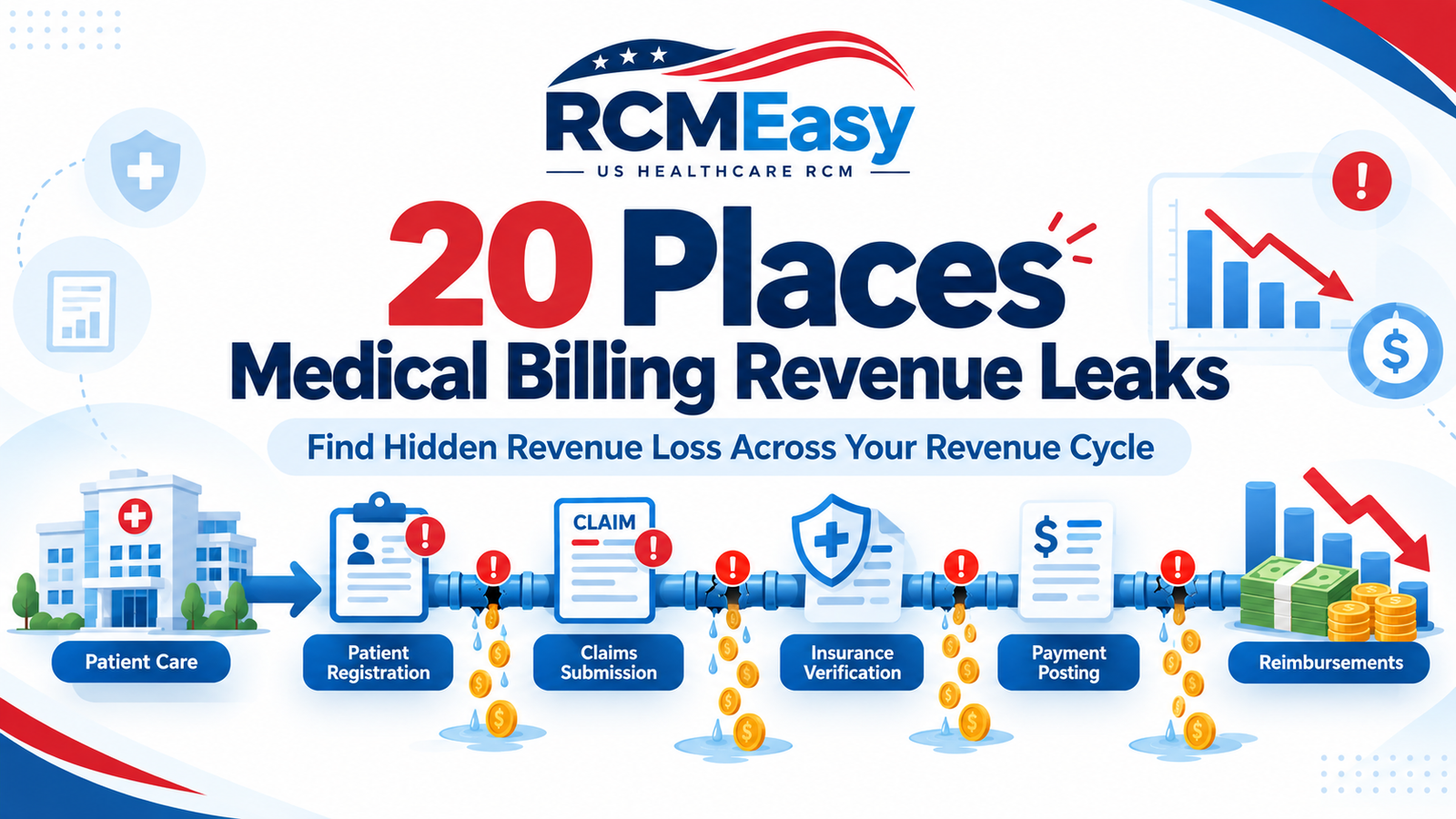
Medical Billing Revenue Leakage: 20 Places Your Practice May Be Losing Money
Revenue leakage often accumulates through small failures. A missed charge, incorrect payer, denied claim, underpayment or old A/R balance can each reduce collections or delay cash.
Use this 20-point medical billing revenue leakage audit to find gaps across the cycle.
20-Point Audit
| # | Leakage point | Audit question |
|---|---|---|
| 1 | Missed charges | Do encounters match charges? |
| 2 | Coding errors | Does documentation support coding? |
| 3 | Eligibility | Was coverage correct? |
| 4 | Authorization | Was required approval obtained? |
| 5 | Rejections | Are queues worked daily? |
| 6 | Denials | Are denied balances worked? |
| 7 | Underpayments | Are payments compared with expected? |
| 8 | Timely filing | Are payer deadlines tracked? |
| 9 | A/R | Are old balances worked? |
| 10 | Patient collections | Are balances followed consistently? |
| 11 | Credentialing | Are enrollment records current? |
| 12 | Contract issues | Are payer terms monitored? |
| 13 | Payment posting | Are remittances reconciled? |
| 14 | Refunds | Are credits reviewed? |
| 15 | Duplicate billing | Are duplicates prevented? |
| 16 | Documentation | Does the record support services? |
| 17 | Charge capture | Are billable services captured? |
| 18 | Modifiers | Are modifiers supported? |
| 19 | Payer information | Is the correct payer routed? |
| 20 | Reporting | Can leadership see the gaps? |
How to Audit the 20 Points
- Missed charges: reconcile encounters to charges.
- Coding: sample records against billed codes.
- Eligibility: analyze front-end errors by payer.
- Authorization: compare required services with approvals.
- Rejections: measure time to correction.
- Denials: group by root cause and value.
- Underpayments: compare against reliable contract data.
- Timely filing: track payer-specific deadlines.
- A/R: review aging and ownership.
- Patient collections: review statement and follow-up timing.
- Credentialing: verify provider enrollment data.
- Contracts: review reimbursement rules.
- Posting: reconcile ERA and EOB information.
- Refunds: review credit balances.
- Duplicates: review claim history and system edits.
- Documentation: verify support for services.
- Charge capture: reconcile procedure logs.
- Modifiers: review patterns for accuracy.
- Payer information: validate payer ID and plan.
- Reporting: make leakage visible by payer and root cause.
Revenue Leakage vs Denials
Denials are visible because the payer communicates a problem. Leakage can be invisible. A missed charge or chronic undercoding may never create a denial. That is why revenue integrity requires review of the whole cycle.
RCMEasy’s revenue cycle management services connect front-end controls with back-end recovery.
How to Run the Audit
- Select a representative period.
- Pull encounter, claim, remittance and A/R data.
- Score each point as controlled, inconsistent or high risk.
- Estimate financial impact where data supports it.
- Prioritize high-value and high-frequency issues.
- Assign an owner.
- Re-measure.
Frequently Asked Questions
What is medical billing revenue leakage?
It is revenue that is missed, delayed, under-collected or incorrectly written off because of revenue-cycle failures.
Where does leakage occur?
Common areas include charge capture, eligibility, authorization, coding, denials, underpayments and A/R.
How often should a practice audit leakage?
Use ongoing KPI monitoring plus periodic deeper audits based on risk and practice complexity.
Find the Gaps Before They Become Losses
Request an RCMEasy revenue cycle assessment.
Sources
Last reviewed: September 3, 2026.
Related RCMEasy guide: Continue with this revenue cycle resource.
Revenue Leakage Audit by RCM Stage
| Stage | Leakage check |
|---|---|
| Patient access | Demographics, eligibility and authorization |
| Clinical | Documentation and charge capture |
| Coding | Code selection and modifiers |
| Claims | Edits, rejection and timely filing |
| Adjudication | Denials and underpayments |
| Posting | Payment and adjustment accuracy |
| A/R | Aging and recovery |
| Patient collections | Statements and follow-up |
Turn Findings Into Projects
Do not create a long list of problems without ownership. Select the highest-value leakage points, assign a responsible team, define the corrective action and set a date to re-measure. The audit becomes valuable when it changes the workflow.