R
C
M
E
A
S
Y
Best Medical Billing Services for Small Practices: What to Compare in 2026
There is no honest universal “best” billing company for every small practice. The right provider depends on specialty, payer mix, volume, EHR, reporting needs and how much work the practice wants to retain.
This guide does not fabricate a Top 10 ranking. It gives small practices an objective way to compare the best medical billing services for small practices based on fit.
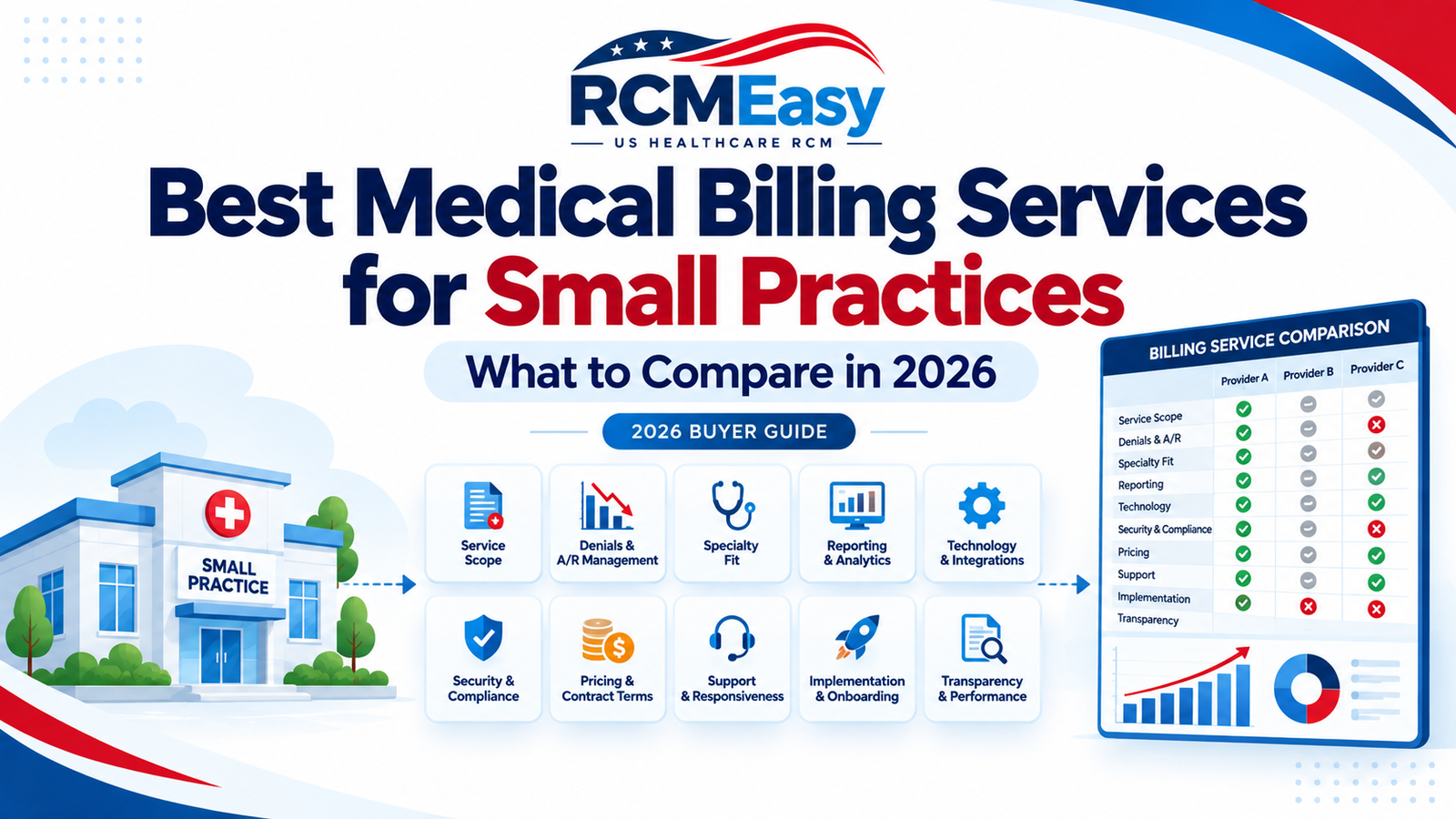
What to Compare
| Factor | What to evaluate |
|---|---|
| Pricing | Fee basis, minimums and exclusions |
| Services | Eligibility, coding, claims, denials, A/R |
| Specialty | Relevant coding and payer experience |
| Technology | EHR, clearinghouse and reporting |
| Denials | Root-cause analysis and appeals |
| A/R | 90+ day recovery |
| Reporting | Useful KPIs |
| Contract | Term, termination and data |
| Scalability | Support as the practice grows |
| Support | Account management and communication |
| Implementation | Migration and go-live |
| Transparency | Clear ownership and scope |
Start With Scope
List every function you need before requesting quotes. A claims-only service is not equivalent to a full RCM service that includes coding, denials and A/R.
Compare Pricing
Ask what the fee applies to and list every additional cost. Normalize proposals to the same scope.
Check Specialty Fit
Ask the vendor to explain common denial causes in your specialty. Generic billing knowledge is not a substitute for relevant experience.
Evaluate Denials and A/R
Ask how the vendor measures denials by payer and root cause and who owns 90+ day A/R. These answers often matter more than a small difference in the quoted fee.
Review Reporting
Ask for sample reports showing claims, denials, A/R aging, collections and workflow exceptions.
Contract Checklist
- Pricing definition
- Scope and exclusions
- Data ownership
- Security and BAA terms
- Termination notice
- Transition assistance
- Open A/R ownership
Small Practice Scorecard
| Category | Weight |
|---|---|
| Service scope | 20% |
| Denials and A/R | 20% |
| Specialty fit | 15% |
| Reporting | 15% |
| Technology | 10% |
| Security | 10% |
| Pricing and contract | 10% |
Where RCMEasy Fits
RCMEasy provides medical billing services and RCM services. Evaluate RCMEasy with the same criteria used for other vendors.
Frequently Asked Questions
What are the best billing services for small practices?
The best service is the one that fits the practice’s specialty, payer mix, technology and financial needs while providing transparent scope and measurable performance.
Is the lowest fee the best option?
No. Compare total cost and service scope.
Should a small practice use a large company?
Not necessarily. Compare account management, specialty experience, reporting and service depth.
Make the Decision With a Scorecard
Talk with RCMEasy about your current billing model and compare the fit.
Sources
Last reviewed: September 3, 2026.
Related RCMEasy guide: Continue with this revenue cycle resource.
How to Compare Billing Companies Fairly
Give every candidate the same practice profile: specialty, approximate claim volume, payer mix, current billing functions, EHR, A/R aging and desired scope. Ask each provider to price the same requirements.
Technology Questions
- Which EHR and practice-management systems are supported?
- How are claims transmitted?
- How are rejections surfaced?
- How are reports delivered?
- How is access secured?
Implementation Questions
A small practice cannot afford a billing transition that interrupts cash flow. Ask who owns data migration, payer setup, open claims, open A/R, testing and staff training.
Support Questions
Ask who you contact when a high-value claim is denied. Then ask how escalation works when the first contact cannot resolve it.
Financial Questions
Ask how the provider measures collections, denials and A/R. The service should make the financial effect visible instead of reporting only completed tasks.
RCMEasy as an Option
RCMEasy provides medical billing services and broader RCM support. Use the buyer criteria in this article to determine whether its model fits your practice.
Frequently Asked Questions
Should a small practice outsource all billing?
Not necessarily. Some practices outsource selected functions such as coding, denials or A/R while retaining patient-facing work.
What should a small practice prioritize?
Prioritize reliable claims, denial management, A/R follow-up, transparent reporting and a contract with clear scope.
Related RCMEasy guide: Review the medical billing KPI guide and revenue leakage audit.
Small Practice Buying Checklist
- Write your required scope.
- Provide identical information to each vendor.
- Normalize pricing.
- Review sample reports.
- Interview the account manager.
- Check specialty experience.
- Review security and contract terms.
- Score the finalists.
Fit Over Fame
A well-known vendor is not automatically the best fit. A small practice needs a service model that provides clear ownership, practical communication and enough specialized capacity for its actual workload.