R
C
M
E
A
S
Y
Medical Billing for Multi-Provider Practices: Workflow and Vendor Checklist
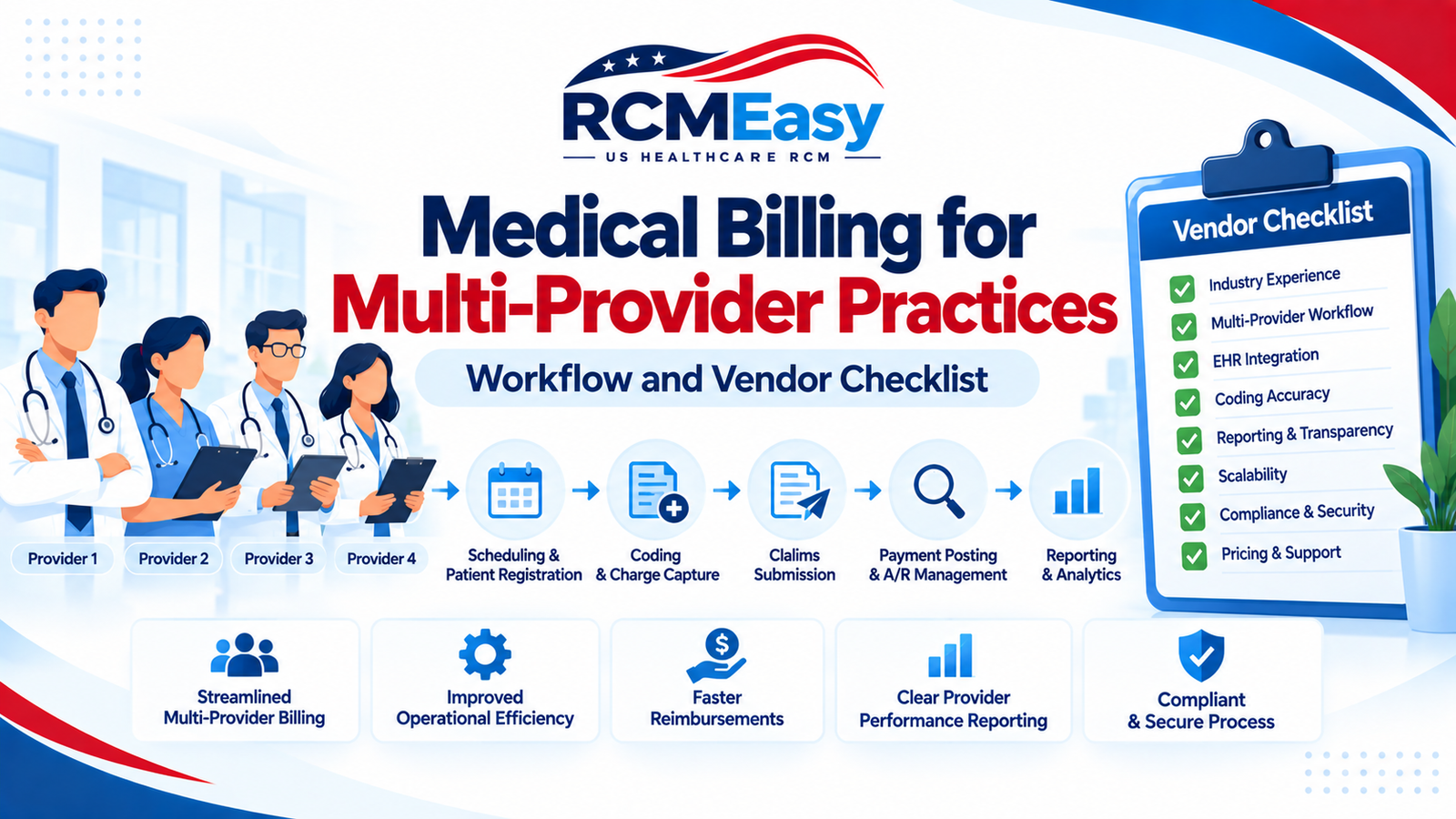
Multi-provider practices need billing workflows that can scale across providers, locations, specialties and payer mixes. The core challenge is maintaining consistent processes while giving leadership enough reporting to identify exceptions.
What Changes as a Practice Grows
More providers can create more claim volume, more payer variation and more opportunities for workflow differences. A scalable billing process should define ownership, standardize routine work and make exceptions visible.
Core Workflow
- Patient registration and insurance information
- Eligibility and authorization checks
- Charge capture and coding
- Claim creation and submission
- Rejection and denial work
- Payment posting and reconciliation
- A/R follow-up
- Reporting and management review
Provider-Level Reporting
Leadership should be able to identify meaningful differences without assuming that every variation is a billing problem. Useful reporting can include charges, collections, A/R aging, denial categories, rejection volume and unresolved work by provider or location.
Standardization Checklist
- Document common billing workflows.
- Define responsibility for each queue.
- Use consistent denial categories.
- Set A/R follow-up priorities.
- Standardize reporting definitions.
- Review payer-specific issues.
- Document escalation paths.
- Control system access by role.
When Evaluating an Outsourced Billing Partner
Ask how the provider handles multiple clinicians, locations, specialties and payer requirements. Confirm how data is separated and reported, how exceptions are escalated and how implementation will be managed.
| Area | Questions |
|---|---|
| Claims | How are submission errors and rejections handled? |
| Denials | Are root causes categorized and reported? |
| A/R | How are aging accounts prioritized? |
| Coding | How are coding questions and documentation gaps escalated? |
| Reporting | Can results be reviewed by provider and location? |
| Technology | Which practice-management and EHR systems are supported? |
Implementation Checklist
- Document current workflows.
- Inventory systems and user access.
- Map providers, locations and payer relationships.
- Define reporting requirements.
- Review open claims and A/R.
- Establish denial and escalation workflows.
- Set a transition timeline.
- Confirm data access and security responsibilities.
Relevant RCMEasy Resources
Explore Revenue Cycle Management, the RCM company checklist, and RCM pricing models.
Frequently Asked Questions
What should multi-provider practices report?
Reporting can include collections, A/R aging, denials, rejections and unresolved work, with useful breakdowns by provider or location where appropriate.
How can a practice standardize billing?
Document workflows, define ownership, use consistent categories and review exceptions through a regular management process.
What should a billing vendor explain before implementation?
The vendor should explain scope, responsibilities, system access, reporting, transition work, security practices, pricing and termination terms.
More resources: Medical Billing Glossary and Downloadable Guides.
Related service: Medical Billing Services.