R
C
M
E
A
S
Y
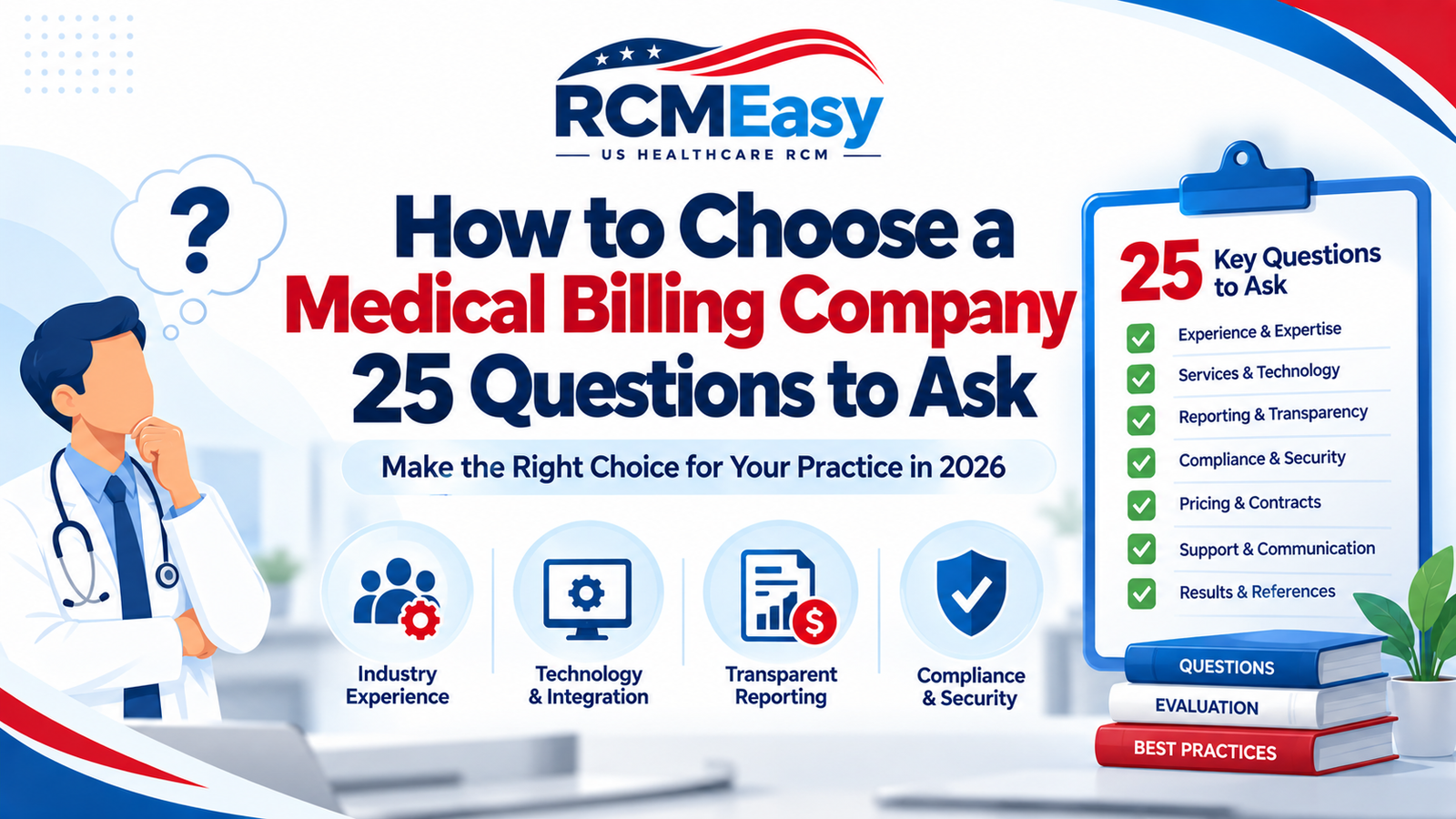
How to Choose a Medical Billing Company: 25 Questions to Ask Before Signing
A billing company should reduce administrative burden, improve visibility and protect collections. The wrong partner can create more reconciliation work. Use these 25 questions to evaluate a vendor before signing.
25-Question Checklist
| # | Question | Why it matters |
|---|---|---|
| 1 | How is pricing calculated? | Prevents surprises |
| 2 | What is included? | Defines scope |
| 3 | What is excluded? | Finds add-ons |
| 4 | How are collections defined? | Normalizes proposals |
| 5 | Do you support our specialty? | Tests expertise |
| 6 | Who performs coding? | Protects accuracy |
| 7 | Who works denials? | Protects recovery |
| 8 | Who works 90+ day A/R? | Protects aging revenue |
| 9 | How are underpayments found? | Protects contract revenue |
| 10 | How is credentialing handled? | Protects enrollment |
| 11 | Which EHRs are supported? | Tests integration |
| 12 | What reports are included? | Tests transparency |
| 13 | Can reports be customized? | Supports management |
| 14 | How is HIPAA addressed? | Protects PHI |
| 15 | Will you sign a BAA? | Clarifies relationship |
| 16 | How is data secured? | Tests controls |
| 17 | Who is our account manager? | Defines accountability |
| 18 | How often do we meet? | Sets communication |
| 19 | What is implementation? | Reduces transition risk |
| 20 | How are open claims migrated? | Protects A/R |
| 21 | Which KPIs are reported? | Creates targets |
| 22 | Can you provide references? | Validates claims |
| 23 | What are termination terms? | Protects exit |
| 24 | Who owns data at termination? | Protects continuity |
| 25 | How are performance problems escalated? | Creates accountability |
Vendor Scoring Framework
| Category | Suggested weight |
|---|---|
| Scope and specialty expertise | 20% |
| Denials and A/R | 20% |
| Reporting | 15% |
| Technology | 15% |
| Security | 10% |
| Pricing and contract | 10% |
| Implementation and support | 10% |
Weighted score = category score × category weight, added across categories.
What to Inspect Closely
Pricing
Ask for a sample invoice and define the collection base. Confirm minimums and separate charges.
Denials and A/R
Ask how denials are categorized, how appeals are tracked and how 90+ day balances are prioritized.
Security
Ask about access controls, safeguards, incident procedures, data ownership and the business associate agreement.
Implementation
- Assign an internal owner.
- Inventory systems and payer portals.
- Define open A/R ownership.
- Test claims and reports.
- Set go-live criteria.
- Review performance at 30, 60 and 90 days.
Red Flags
- Unclear fee base
- Extensive exclusions
- No clear denial ownership
- No 90+ day A/R process
- Weak reporting
- Vague security answers
- No transition plan
RCMEasy provides medical billing services, denial management and A/R management.
Frequently Asked Questions
Should price decide the choice?
No. Compare scope, financial outcomes, reporting, security and transition risk.
How many vendors should I compare?
Two or three detailed, normalized proposals can provide a useful comparison.
What is the biggest contract risk?
Unclear scope and collection definitions. Make every included and excluded service explicit.
Choose With Evidence
Request a consultation with RCMEasy and use this same scorecard for any vendor.
Sources
Last reviewed: September 3, 2026.
Related RCMEasy guide: Continue with this revenue cycle resource.
Questions About Performance
Ask the vendor which KPIs it will own and how often you will review them. Useful measures include clean claim rate, denial rate, A/R aging, payment turnaround, collection performance and underpayment exceptions. Ask how the vendor defines each metric.
Questions About Data
- How will the practice access reports?
- How often is data refreshed?
- Who can access patient information?
- How are access changes handled?
- What happens to data when the contract ends?
Questions About Communication
Define response expectations, escalation contacts and meeting cadence. A vendor can have good systems and still perform poorly if communication is unclear.
Questions About Transition
Ask for a written implementation plan. It should identify system access, open A/R, payer portals, provider information, claim submission testing, payment posting and reporting.
Reference Checks
Ask references about implementation, communication, reporting, denial ownership and how the vendor responded when performance changed. Do not ask only whether the vendor was “good.” Ask for specific operational examples.
Final Selection Rule
Choose the provider with the strongest combination of scope, specialty knowledge, financial controls, reporting, security, communication and contract clarity. Price should be part of the decision, not the entire decision.
RCMEasy offers revenue cycle management services that can be evaluated with this same scorecard.
Related RCMEasy guide: Review the medical billing KPI guide and revenue leakage audit.
Reference-Check Questions
- Was implementation completed on the promised timeline?
- Were reports accurate and understandable?
- Did the vendor actively work old A/R?
- How were denial problems escalated?
- How responsive was account management?
- What happened when payer rules changed?
Contract Review
Have the final agreement reviewed by the appropriate business and legal stakeholders. Confirm pricing definitions, data ownership, security obligations, performance measures and exit procedures before signing.